To adjust your footrest for maximum comfort, start by setting the angle between 15° and 30° to support good circulation and reduce swelling. Confirm your feet are fully supported with knees bent at about 90° and your hips aligned. Make small, regular adjustments to find the most supportive position, locking all knobs securely. Experiment with slight tilt changes during long sessions to prevent stiffness and boost blood flow. If you want expert tips, keep exploring this guide.
How to Adjust Your Footrest for Maximum Comfort
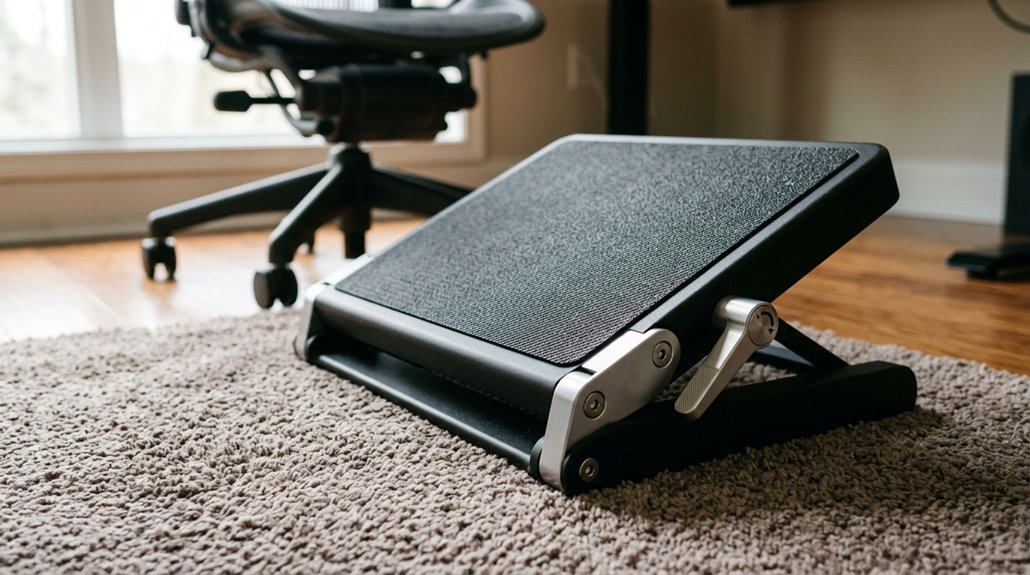
To achieve maximum comfort, start by adjusting your footrest so your knees form about a 90-degree angle, with your feet fully supported on the surface. This position helps prevent dangling feet and reduces pressure on your legs.
Next, adjust the angle of the footrest by inclining or tilting it between 15° to 30°, which supports lower back relaxation and encourages proper heel-toe placement. Make sure to experiment with the adjustable height feature to find the most supportive position for your legs.
Periodically shift the footrest angle and synchronize adjustments with your chair’s height to avoid stiffness and leg fatigue, maintaining healthy circulation.
After setting the ideal position, lock all adjustment knobs securely to guarantee stability and consistent comfort throughout your seated periods.
Why Footrest Angle Matters for Good Posture
Adjusting your footrest angle plays a crucial role in maintaining good posture because it directly influences the alignment of your pelvis and spine. When your footrest is set at about 15-30 degrees, it helps support a balanced heel-toe positioning, which reduces pressure on your legs and knees. This setup encourages a natural, slightly open angle between your knees and hips, preventing stiffness and promoting better blood circulation. Improved circulation decreases leg swelling and fatigue, allowing you to sit comfortably longer. Additionally, incorporating a tilt/rocking feature can facilitate subtle leg movements that further enhance circulation and reduce stiffness. Regularly modifying your footrest tilt, along with chair height adjustments, encourages dynamic posture shifts that prevent strain and back discomfort. Fundamentally, optimizing your footrest angle keeps your pelvis properly supported, helping you achieve better posture and maintain overall comfort during long periods of sitting.
Choosing the Right Footrest Angle for Your Body
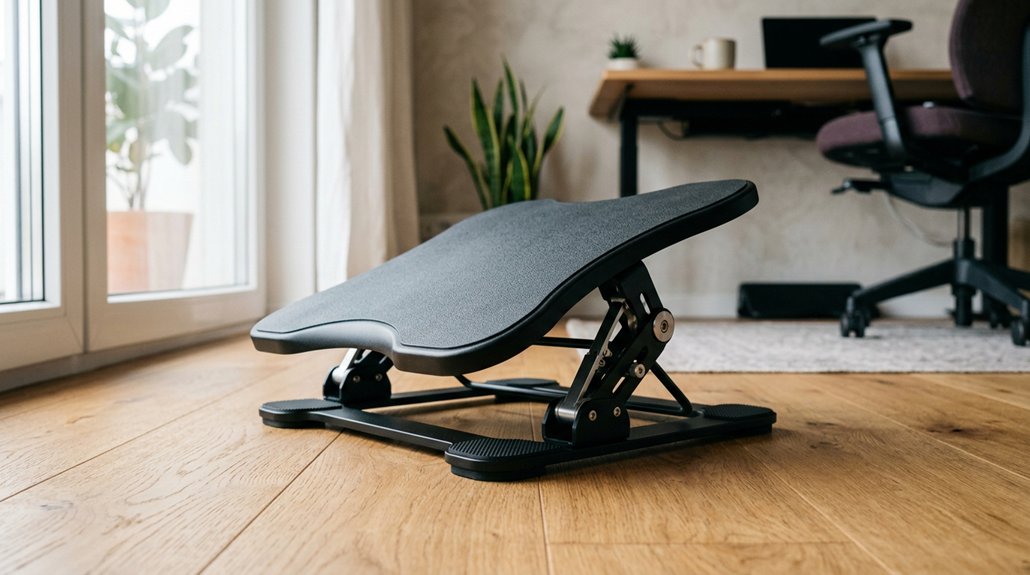
Choosing the right footrest angle depends on your comfort, circulation needs, and posture goals. You’ll want to adjust it to support healthy blood flow, reduce swelling, and keep your knees and hips aligned. Exploring different rocking modes can also help you find the most effective position for active movement and posture support. Experimenting with different angles helps you find the most comfortable position that also promotes good spinal and pelvic alignment.
Individual Comfort Preferences
Finding the right footrest angle is a matter of personal comfort and ergonomic support. The ideal footrest angle varies based on your preferences, but generally, between 15° to 30° offers best results.
For those prone to leg swelling, a 30° angle helps improve circulation and reduce discomfort, while 15° provides standard comfort. It’s important to adjust the incline to keep your knees at a natural 90°, avoiding rigid angles that can cause pressure or stiffness.
Your comfort also depends on factors like lower back support and heel-to-toe balance. Experimenting with adjustable footrests, especially those with +/-20° tilt, can help you find the perfect angle that minimizes leg fatigue and supports your overall sitting posture. Additionally, tilt/angle adjustments vary from 0° to ±30°, allowing personalized customization for maximum ergonomic benefit.
Circulation and Swelling
Maintaining the right footrest angle plays a key role in supporting healthy circulation and reducing swelling in your legs. A 30-degree tilt is especially effective for promoting better blood flow, as it helps prevent blood pooling in the lower legs.
Keeping your knees at about a 90-degree angle with your feet fully supported stops pressure points that can lead to leg heaviness and fatigue. Periodically adjusting the footrest angle encourages micro-movements, stimulating circulation and preventing stiffness and edema.
Choose a footrest with adjustable incline and cushioning for tailored support of your circulation needs. Proper support and foam density are critical in maintaining comfort and stability throughout the day, ensuring your legs stay healthy and pain-free. By finding the right angle for your body, you help maintain ideal blood flow throughout the day, reducing swelling and improving overall leg comfort.
Posture and Alignment
To support proper posture and alignment while sitting, it’s important to set your footrest to an angle that keeps your pelvis and spine in a comfortable, balanced position. An ideal footrest angle promotes better posture by guaranteeing your knees are roughly at a 90-degree bend, distributing pressure evenly. Slightly open angles between your knees and hips, around 15 to 30 degrees, help maintain natural alignment and relax your lower back. Adjusting the footrest periodically, synchronized with your chair height, prevents stiffness and leg fatigue. Properly set, it minimizes slouching, reduces lower back strain, and encourages good posture. Proper support and cushioning—like ergonomic lumbar cushions—also play a crucial role in achieving optimal sitting comfort and spinal alignment.
Matching Your Footrest to Your Seat and Desk Height
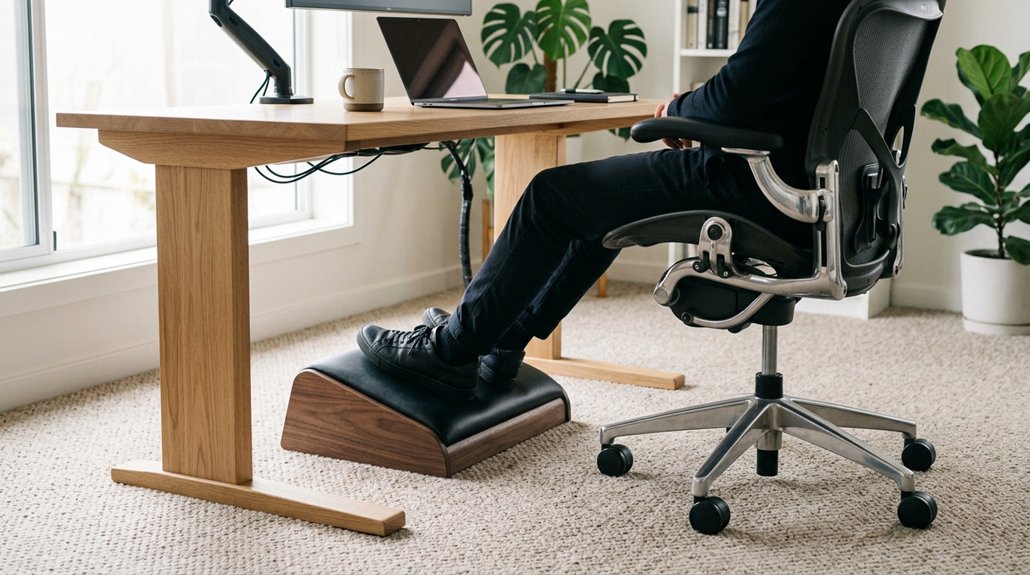
Guaranteeing your footrest aligns properly with your seat and desk height is essential for maintaining comfort and good posture.
Adjust your footrest height so your knees form a natural 90-degree angle, with your feet fully supported, preventing dangling legs or excess pressure that can hinder circulation.
Synchronize the footrest angle and height with your seat height and desk setup, helping to keep your pelvis and spine correctly aligned, which reduces leg fatigue.
Experiment with footrest tilt settings between 15° to 30°, opting for lower angles during routine work and higher inclines to minimize leg swelling during long sitting periods.
Confirm your feet are evenly supported without hard edges under the calves, especially when reclining or using adjustable chairs, for sustained comfort.
Proper footrest positioning also benefits from understanding ergonomic posture principles, ensuring the entire seated posture remains aligned and comfortable.
Fine-Tuning Your Footrest During Long Work Sessions
How can you optimize your footrest during long work sessions? Adjust your footrest angle to keep your legs and feet comfortable over long hours. Aim for a natural knee bend of about 90°, supporting your feet fully. Experiment with a tilt between 15° and 30°; a 30° incline can help reduce leg swelling and improve circulation. Change the footrest angle periodically to encourage micro-movements, prevent stiffness, and promote healthy blood flow. Sync your footrest adjustments with chair height to avoid pressure on your ankles. Consider models with adjustable tilt features, like memory foam or cushioned types, for tailored support. Here’s a quick look at different inclines and their benefits:
| Footrest Angle | Benefits | Suitable For |
|---|---|---|
| 15° | Supports neutral position | No swelling |
| 20° | Slight elevation, comfort | All-day use |
| 25° | Improves circulation | Long hours |
| 30° | Reduces leg swelling | Swelling concerns |
Adjusting the anti-fatigue mats or footrest angle can also help adapt your workspace setup for maximum comfort.
Common Mistakes to Avoid When Setting Up Your Footrest
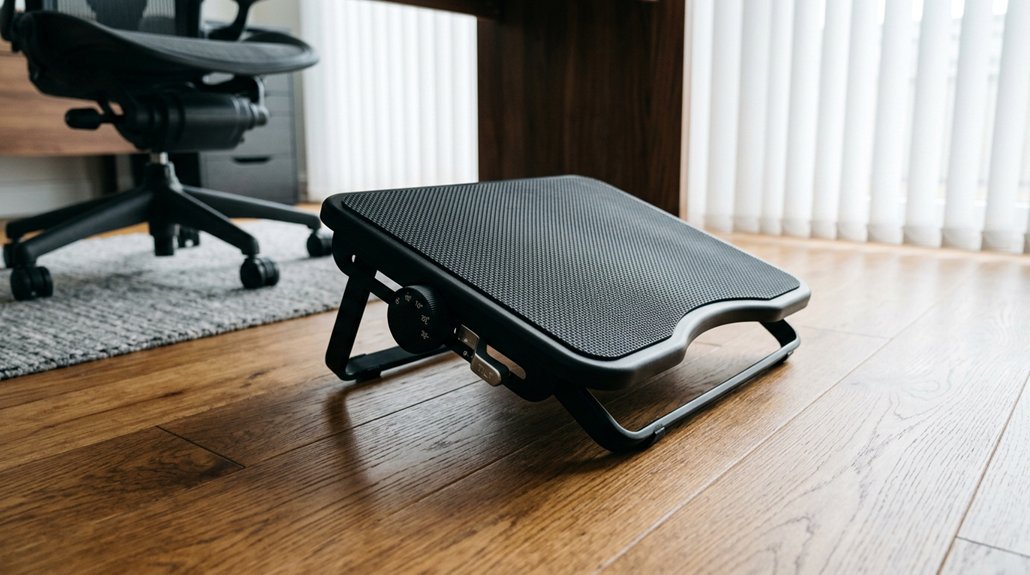
Are you setting your footrest correctly, or could you be making common mistakes that hinder comfort and health? One mistake is keeping the footrest angle too rigid at 90 degrees in relaxed seating, which can lead to poor circulation and leg fatigue. Remember to adjust it periodically; a static position causes stiffness and decreases blood flow.
Also, avoid positioning the footrest too high or low—this can put excessive pressure on your hips or cause dangling feet, disrupting knee and ankle alignment. Never forget to secure adjustment knobs properly, as loose settings can wobble or shift unexpectedly.
Finally, ignore your natural tilt preferences, like a slight 15–30 degree incline, which helps promote circulation and reduce swelling. Proper ergonomic adjustments ensure comfort and prevent poor posture over time.
How to Prevent Leg Fatigue and Swelling With Your Footrest
To prevent leg fatigue and swelling, set your footrest angle between 15 and 30 degrees to boost blood flow. Make sure your feet rest fully on the surface without dangling or applying uneven pressure. Using a footrest with ergonomic design features like a contouring surface can further enhance support and comfort. Regularly adjust the height and angle to encourage micro-movements that keep circulation active and muscles relaxed.
Optimal Footrest Angle
Finding the right footrest angle is key to preventing leg fatigue and swelling during long periods of sitting. The correct position usually involves setting your footrest to an angle of about 15 to 30 degrees, which is supported by a 2014 Japanese study showing that a 30-degree tilt is especially effective for reducing swelling. Proper coccyx support can also enhance comfort and promote spinal alignment. This angle allows your knees to rest at roughly 90 degrees, supporting proper blood flow and relieving pressure on your legs. Experiment with various footrest options and adjustments, as periodic changes help maintain muscle activity and prevent stiffness or restless leg syndrome.
An angled footrest with a slight heel-toe tilt also promotes better circulation and spinal alignment, reducing back discomfort. Avoid rigid, perfectly vertical angles to encourage circulation and leg comfort.
Correct Height Positioning
Ensuring your footrest is set to the correct height is essential for preventing leg fatigue and swelling when sitting for extended periods.
When adjusting the footrest height, aim for your knees to form a comfortable 90-degree angle, with your feet fully resting flat. This position promotes even weight distribution and minimizes leg strain. A proper footrest height helps maintain healthy circulation by reducing unnecessary pressure on your calves and ankles.
Avoid setting the footrest too low, which can cause dragging feet, or too high, which puts excess pressure on your hips—especially important for wheelchair users. Periodically recheck and adjust the height as needed, especially when changing chair height, to prevent stiffness and support better blood flow.
Promoting Blood Circulation
Adjusting your footrest to support natural leg elevation can greatly improve blood flow and reduce the risk of leg fatigue and swelling. Set your footrest to about a 30-degree tilt to promote better circulation by supporting your feet and legs in a more natural position.
Ensuring your feet rest flat on the footrest with knees around a 90-degree angle prevents pressure buildup and helps maintain healthy blood flow during long periods of sitting. Periodically adjusting the footrest’s incline and height every hour encourages micro-movements that reduce fatigue and stiffness.
Avoid overly rigid 90-degree angles in relaxed seating, as natural slopes enhance venous return and minimize blood pooling. Using a cushioned, adjustable footrest that cradles your calves helps sustain balanced blood flow while reducing localized pressure.
Best Features to Look for in an Adjustable Footrest
When selecting an adjustable footrest, you should focus on features that allow for a customizable and stable experience. Look for an adjustable footrest with a wide incline range, like ±20°, so you can fine-tune the height and angle for maximum comfort and proper circulation.
Multi-angle and height adjustments are essential to guarantee your knees form about a 90-degree angle and your feet rest flat, preventing dangling or strain. Stability is key, so choose models with non-slip surfaces and sturdy materials such as steel or high-density foam.
Anti-slip rubber bottom pads and locking mechanisms on knobs or levers are crucial for securely maintaining your preferred angle without wobbling. Removable, washable cushions or breathable covers can add a layer of comfort for long sitting periods.
Troubleshooting Discomfort or Instability in Your Footrest
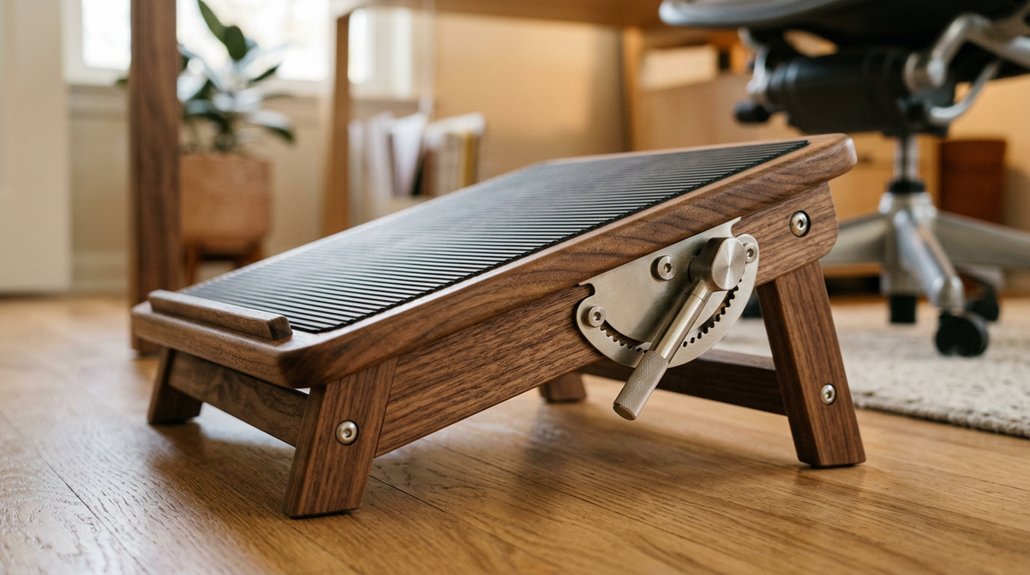
If you notice wobbling or instability in your footrest, the first step is to tighten all adjustment knobs and levers until they click into place. A stable foot rest guarantees your feet are fully supported without slipping or hard edges causing discomfort.
Check that both sides are symmetrically adjusted, preventing uneven pressure or cradling that feels uncomfortable. If your feet are fully supported but wobbling persists, verify the footrest height aligns properly with your hips and knees, ideally at a 90-degree angle, to promote circulation and reduce fatigue.
Gradually adjust the tilt within a +/-20° range to find a comfortable angle that supports your lower back. Make sure the surface is non-slip for a secure, steady footing during use.
Adjusting Footrest for Recliners and Wheelchairs
When adjusting the footrest on recliners and wheelchairs, focus on achieving the right knee angle for comfort and circulation. Make sure the footrest is secure and stable to prevent wobbling or shifts during use.
Fine-tuning the tilt and height can greatly improve relaxation and support, so take the time to set each side evenly.
Ensuring Proper Knee Angles
Maintaining a proper knee angle is essential for comfort and safety when adjusting footrests in recliners and wheelchairs. To achieve this, set the footrest height so your knees form a natural 90-degree angle with feet flat on the footplate. In recliners, use softer cushioning and a slightly laid-back angle to support relaxed posture while keeping knees and hips aligned. In wheelchairs, position the footrest so that the knees are slightly lower than the hips, preventing pressure and slips.
| Recliner | Wheelchair |
|---|---|
| Softer cushioning and a laid-back angle | Slightly lower knees than hips |
| Keeps knees and hips aligned | Guarantees feet stay flat on footplate |
| Supports relaxed posture | Promotes comfort and mobility |
Adjusting for Comfort Levels
Adjusting the footrest for comfort involves fine-tuning both the footrest angle and position to match your personal preferences and activities.
To find the right footrest angle, try soft cushioning and a laid-back posture in recliners, which helps keep your pelvis and spine aligned, boosting comfort during long sitting periods.
In wheelchairs, set the footrest height so your feet rest flat on the footplate, with knees at a natural 90° angle—avoiding dragging or hip pressure. Loosen adjustment knobs or levers gently before repositioning, then lock them securely for stability.
Tilt angle adjustments, if available, provide added comfort by allowing micro-movements that reduce lower-back strain. The goal is to cradle your calves without hard edges and maintain open angles between knees and hips for better comfort and productivity.
Securing Footrest Stability
Securing footrest stability is essential for safety and comfort during use. To achieve this, always securely tighten knobs and levers until they “click,” preventing wobbling and guaranteeing consistent positioning during movement.
For wheelchairs, gently loosen adjustment knobs or levers before repositioning the footplate, then lock them firmly to avoid unintended shifts and maintain a balanced posture.
When adjusting recliner footrests, choose models with locking mechanisms that support a secure hold, especially for extended use. Regularly inspect all attachments and locking mechanisms to confirm durability and stability.
Quick Tips to Maintain Long-Term Comfort
To guarantee long-term comfort, regularly tweak your footrest angle to match your sitting posture and activity level. Adjusting the footrest angle makes it easier to maintain a natural 90-degree knee bend with feet fully supported, preventing leg fatigue and circulation issues.
Experiment with incline settings between 15° and 30°: a 30° tilt helps reduce leg swelling, while 15° is suitable if circulation isn’t a concern. Change the angle periodically throughout the day to promote micro-movements, improve blood flow, and prevent stiffness in your legs and lower back.
Sync your footrest adjustments with chair height changes to avoid excess pressure on knees or hips. Using cushioned, adjustable footrests enhances ergonomic support, making it easier to maintain better comfort across extended periods.
How to Find the Right Footrest for Your Needs
Finding the right footrest begins with understanding your specific needs and sitting habits. To guarantee proper footrest support, look for models with adjustable height and footrest angle. These features let you customize for comfort, keeping knees at about a 90-degree angle and feet fully supported. Consider models like Desky Memory Foam or Cushioned options with ergonomic adjustments and washable covers.
Use this guide to help compare options:
| Footrest Model | Adjustable Height/Angle | Material & Surface |
|---|---|---|
| Basic Plastic | Yes, 15°-30° incline | Non-slip plastic |
| Memory Foam | Yes, customizable | High-density foam |
| Cushioned Steel | Yes, stable support | Cushioned surface |
| Tilting Platform | Yes, tilting feature | Rubberized surface |
| Ergonomic Design | Yes, for circulation | Mixed materials |
Choose a proper footrest aligned with your activity and comfort needs.
Expert Recommendations for Ergonomic Footrest Setups
Achieving an ergonomic footrest setup involves fine-tuning the angle to support overall comfort and health during prolonged sitting. Experts recommend setting the footrest angle between 15° and 30°, with a 30-degree incline especially reducing leg swelling, while 15° suits those without circulation concerns.
Make certain your footrest allows feet to rest fully flat, maintaining a balanced heel-toe position that supports proper lower back alignment and reduces strain. Periodically adjusting the footrest angle to match chair height prevents stiffness and leg fatigue, encouraging micro-movements that promote circulation.
For wheelchair users, slight tilts cradle the calves comfortably without creating pressure points. Ergonomic footrests with adjustable tilt mechanisms, such as Desky models, offer fine-tuning within a ±20° range, enabling personalized comfort during long sitting sessions.
Frequently Asked Questions
What Is the Optimal Footrest Angle?
The ideal footrest angle is between 15° and 30°, with 30° reducing leg swelling. You should adjust to a comfortable, slightly tilted position that supports healthy blood flow, reduces fatigue, and aligns your pelvis and spine properly.
Should a Footrest Be Flat or Angled?
You should angle your footrest slightly, around 15 to 30 degrees, for better circulation and comfort. A flat footrest works if you don’t experience swelling, but an angled one maintains proper posture, reducing fatigue and back strain.
Should Your Knees Be at a 90 Degree Angle for Ergonomic Seating?
Yes, your knees should form about a 90-degree angle for ergonomic seating. This position helps maintain proper posture, reduces lower back strain, and encourages healthy circulation, making your seated experience more comfortable and preventing fatigue over time.
What Angle Should Your Feet Be When Sitting?
You should keep your feet at a 15 to 30-degree angle when sitting, ensuring your knees are close to 90 degrees, supporting circulation, reducing pressure, and maintaining comfort during long periods of sitting.
In Summary
To stay comfortable and avoid strain, regularly adjust your footrest angle to suit your posture and workspace. Experiment with different positions until you find what feels best, especially during long periods of sitting. Remember, the right footrest setup supports your back and legs, making your work sessions more comfortable and productive. Keep fine-tuning your setup, and you’ll enjoy improved comfort and better posture every day.