To find your ideal desk height, start by measuring your total height, including shoes, using a wall or stadiometer. For sitting, aim for a desk height of 25-30 inches so your elbows rest at 90°-110°. For standing, set your desk between 38-43.5 inches for comfortable arm and wrist positions. Adjust for personal comfort and use ergonomic furniture or tools to help. Keep exploring for more tips to fine-tune your setup for lifelong comfort.
How to Properly Adjust Your Desk Height for Comfort and Health
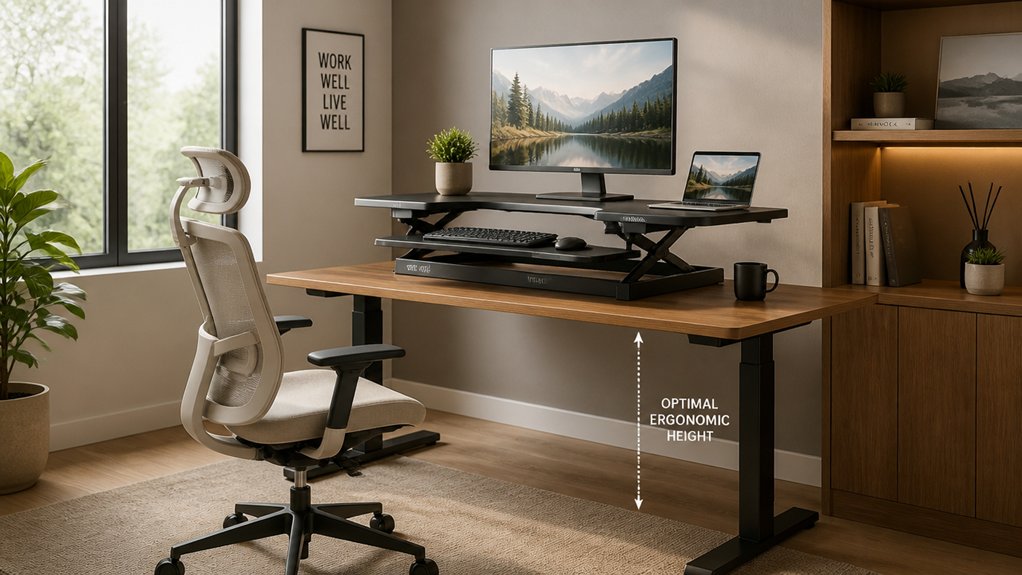
To guarantee maximum comfort and promote good posture, adjusting your desk height correctly is essential. An ergonomic desk height helps minimize strain during sitting or standing.
When sitting, set your desk so your elbows form a 90°–110° angle, with forearms resting comfortably and wrists straight. Your thighs should be parallel to the floor, with feet flat on the ground. Typically, this means a desk height of about 25 to 30 inches (63.5–76 cm).
For standing, position the desk between 40.5 to 43.5 inches (103–110.5 cm), allowing your forearms to relax naturally.
Use adjustable furniture to fine-tune your desk height based on body size and tasks, ensuring your monitor is at eye level and your shoulders stay relaxed. Incorporating adjustable monitor stands can further help achieve optimal ergonomic positioning for multi-screen setups.
What Are Typical Desk Heights for Sitting and Standing?
What’re the typical heights for sitting and standing desks?
A standard desk height usually ranges from 25 to 30 inches, with 28-30 inches being common in U.S. offices, suitable for about 6-foot-tall users.
Standing desk heights generally fall between 38 and 42 inches, with a recommended range of 40.5 to 43.5 inches for someone 5 ft 7 in tall wearing shoes. To find the right standing desk height, a standing desk height calculator can help.
For sitting, an ergonomic chair combined with a desk at 25-30 inches allows elbows to form a 90°-110° angle.
Using an adjustable desk allows you to customize the height for comfort, promoting healthier posture whether sitting or standing. Maintaining a stable and sturdy surface is key for ergonomic comfort and safety, especially at full height, which can be supported by strong, reinforced frames.
How Do You Measure Your Height and Shoe Thickness Accurately?
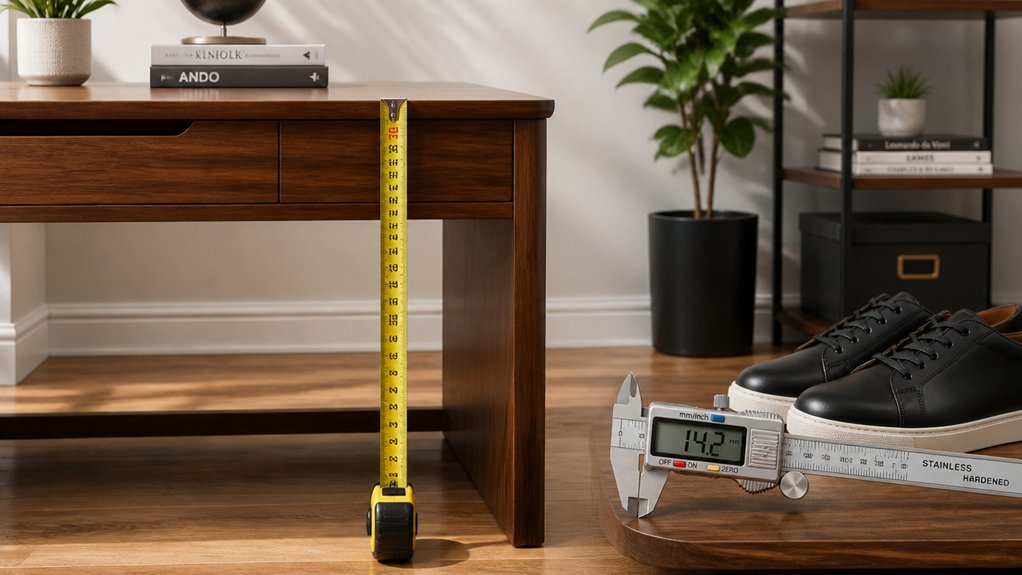
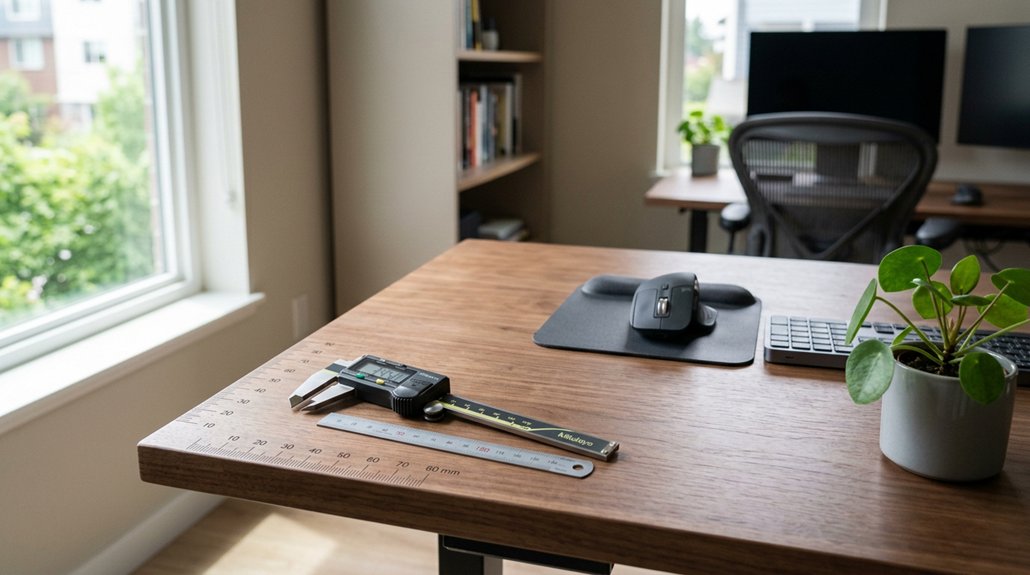
Ever wondered how to measure your height and shoe thickness accurately for ergonomic purposes? To get an accurate height, stand straight against a wall, making sure your heels, back, and shoulders touch the wall, with your head level. Use a wall-mounted measuring tape or stadiometer to measure from the floor to the top of your head. Don’t forget to include shoe height—usually about 1 inch—by wearing the shoes you commonly use during measurement. For shoes with thicker heels, measure with those shoes on to get precise data. Record your total height, combining your height and shoe height, in inches or centimeters. This combined measure is essential for calculating the correct desk height that offers comfortable ergonomics and supports your posture throughout the day. Additionally, considering ergonomic lumbar support and proper seat height can significantly enhance your overall comfort.
How to Use Our Desk Height Calculator to Find Your Perfect Starting Point
Start by entering your height with your most-worn shoes on, as footwear impacts your measurement.
Then, choose your preferred working position—sitting or standing—to get tailored desk and monitor recommendations.
Use these suggested ranges as a starting point and adjust them to guarantee comfort and ergonomic alignment.
Additionally, consider the adjustable height and angle features of laptop stands to ensure you can customize your workspace for optimal neck and eye comfort.
Input Height and Shoes
To get the most accurate desk height recommendation, you need to enter your full height plus the height of your most-worn shoes into the desk height calculator. This means including the added height from your heels or soles to guarantee the suggestions are tailored to your actual working posture. Incorporating ergonomic considerations such as your footwear ensures the recommended height aligns properly with your elbows and wrists, promoting a comfortable and healthy workspace. An adjustable, height-specific input helps the calculator provide precise recommendations for your chair, desk, and monitor placement, promoting ergonomic comfort. For example, if you’re 5 ft 7 in tall in shoes, the recommended standing desk height range is about 40.5 to 43.5 inches.
Always remember to fine-tune the suggested heights after initial setup for maximum comfort. Using your height with shoes considered guarantees your workspace aligns correctly with your elbow and wrist angles while working.
Select Working Posture
Choosing your primary working posture is a key step when using the desk height calculator. Whether you prefer sitting or standing, selecting the right posture helps tailor the desk height to your needs, promoting ergonomic comfort and posture support. An appropriate adjustable height setup accommodates both positions effectively, ensuring sustained comfort during long work sessions.
- Decide if your main activity involves sitting or standing to get accurate height recommendations.
- For sitting, adjust the chair height so your elbows rest at a comfortable 90°-110° angle.
- If standing, guarantee your desk height aligns with your natural arm position to prevent strain.
The calculator uses your input to suggest ideal ranges for desk and chair height based on your chosen posture. Use these recommendations as starting points and fine-tune your workspace for personalized comfort and peak posture support.
Adjust for Comfort
When using our desk height calculator, begin by entering your full body height, including shoes, since footwear impacts your starting desk height. Use the suggested range as your initial setup, then make slight adjustments for comfort. If you prefer sitting, check that your seat height allows your elbows to form a 90°-110° angle. For standing desks, adjust the desk height for a relaxed arm position at about waist level. Keep in mind personal factors like shoe thickness, arm length, and tasks. Use the table below to visualize how different adjustments can help: adjustment mechanisms.
What Factors Affect Your Ideal Desk Height?
What factors influence your ideal desk height? Your height, with shoes on, is a starting point, typically suggesting height ranges around 40.5 to 43.5 inches for someone who’s 5 ft 7 in. Maintaining an ergonomic posture is vital; your elbows and forearms should form a 90°-110° angle, which guides desk height to prevent strain. Chair height impacts this as well, ensuring your thighs and lower legs are parallel to the floor, usually between 25-30 inches when sitting. Personal body proportions, like arm length and task type, may require additional adjustments beyond standard guidelines. Additionally, considering adjustable height ranges allows for seamless transitions between sitting and standing positions, promoting better long-term comfort.
How Do You Know If Your Desk Setup Needs Fine-Tuning?
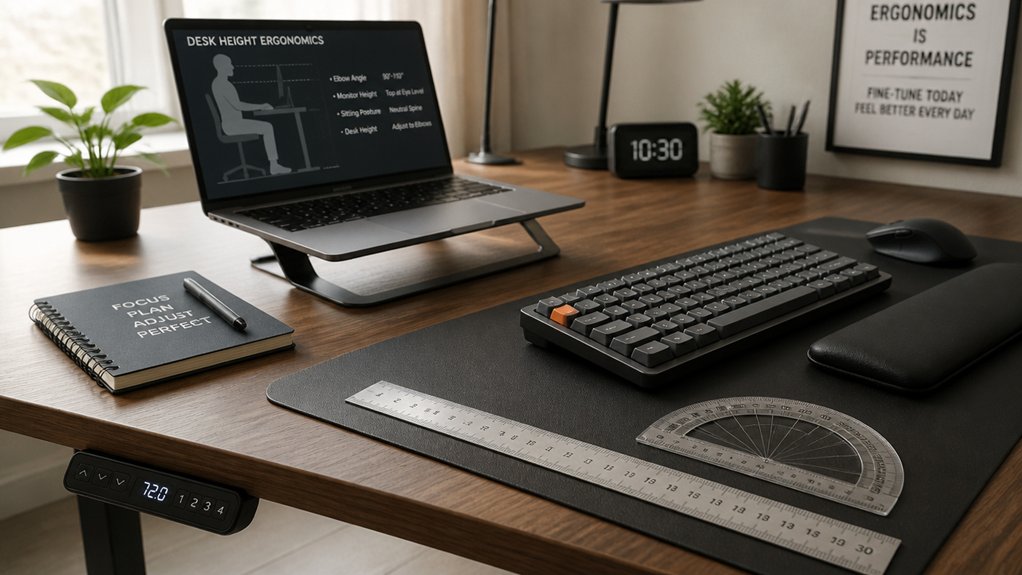
If your current desk setup isn’t feeling quite right, it’s likely time for some fine-tuning. Use an assessment tool to check your posture and determine if your SitStand Desk height needs adjustment.
When sitting, your thighs and feet should be parallel to the floor, with knees at a 90°-110° angle. If you notice your thighs or feet aren’t aligned, or if your elbows don’t form a 90°-110° angle when resting on the desk, it’s a sign to change your desk height.
Also, pay attention to wrist position—if your wrists bend upward or downward while typing, your setup needs correction. Frequent slouching, leaning forward, or discomfort in your shoulders, neck, or back are additional indicators that your desk setup requires ergonomic fine-tuning for ideal comfort.
Why Ergonomic Furniture Makes Proper Desk Height Easier to Maintain
Ergonomic furniture simplifies maintaining the correct desk height by offering easy, adjustable features that suit your individual needs. With height-adjustable desks, you can effortlessly switch between sitting and standing positions, keeping your workspace aligned and comfortable.
Pairing adjustable chairs guarantees proper thigh and lower leg angles, while ergonomic monitor arms keep your screen at eye level for reduced neck strain. Sit-stand desks promote quick height changes, helping you switch positions frequently and maintain ergonomic wrist and elbow angles.
This cohesive setup prevents discomfort and promotes good posture throughout your workday.
- Easily adjust desk height for sitting or standing with sit-stand desks
- Maintain ideal positioning using ergonomic monitor arms for screen support
- Find comfort with adjustable chairs that support proper limb angles
Should You Adjust Your Desk Differently for Sitting and Standing?
Should you adjust your desk differently for sitting and standing? It’s important to take into account the different posture needs and comfort levels for each position, ensuring your elbows and wrists stay in neutral, strain-free positions.
Using a height-adjustable desk makes switching between the two easier and helps maintain proper ergonomic alignment.
Different Posture Requirements
Since your goal is to maintain proper posture, adjusting your desk height for sitting versus standing is essential. For sitting, the height should be around 25 to 30 inches, with the table height to one that allows your elbows to be at a 90° to 110° angle.
When standing, the desk should be roughly 38 to 42 inches so you can keep your elbows straight and wrists neutral. Keep in mind, the monitor should be tilted slightly for ideal viewing.
Two working positions require different adjustments, so your setup needs flexibility. An adjustable desk makes it easier to switch heights smoothly, promoting ergonomic alignment in both postures. Properly set, your desk supports neutral wrist and elbow positions, preventing strain across your workday.
Adjustments for Comfort
Adjusting your desk height for sitting and standing positions is key to maintaining comfort throughout the day. For one position, you should set your height-adjustable desk to match your ergonomic needs.
When sitting, aim for a height between 25 and 30 inches, ensuring your elbows stay at a 90°-110° angle with your feet flat on the floor and thighs parallel. When standing, raise the desk to about 38 to 42 inches to keep your elbows in the same bent range and wrists neutral.
Different heights for sitting and standing help prevent neck, shoulder, and wrist strain by maintaining proper posture. Using a height-adjustable desk makes it easy to shift smoothly, supporting comfort and movement during extended work periods.
Tips for Regularly Reassessing and Adjusting Your Desk Setup
Regularly reassessing your desk setup is key to maintaining comfort and avoiding strain. Over time, your body shifts, so it’s important to evaluate your chair, desk, and posture every few months.
When sitting, your feet should be parallel and flat on the floor, and your elbows should stay at a 90-110° angle. If you switch between sitting or standing, an adjustable desk makes it easier to stay in the ideal position.
Regular checks for discomfort or posture shifts help you fine-tune your setup and prevent strain.
- Keep an eye on your chair height and adjust so your feet remain parallel and flat.
- Use an average desk height that supports neutral wrist and arm positions.
- Reassess your setup to guarantee thighs and lower legs form a comfortable 90°-110° angle.
What Are Common Mistakes That Lead to Strain Even If Your Desk Is Correctly Set?
Even with your desk set at the perfect height, poor posture habits can still lead to discomfort and strain. One common mistake isn’t maintaining proper alignment, like slouching or leaning forward, which causes tension regardless of your desk’s position.
Failing to keep your elbows bent at a 90° to 110° angle can also lead to wrist and shoulder discomfort, even if your setup seems correct. Additionally, if you don’t position the monitor so the top third part of the screen is at eye level, you’ll strain your neck and eyes over time.
Using an office chair that doesn’t allow your feet to rest flat on the floor can compound these issues, negating the benefits of an ideally set desk height and leading to ongoing discomfort.
Frequently Asked Questions
How to Figure Out Optimal Desk Height?
To find your ideal desk height, measure your height, then calculate using formulas or start with recommended ranges. Adjust for comfort, making sure your elbows are at 90-110 degrees, and your forearms are parallel to the ground.
How Tall Should a Desk Be for a 5’7″ Person?
For someone who is 5’7″, you should aim for a standing desk height between 40.5 and 43.5 inches. When sitting, your desk should be around 25 to 30 inches to keep your elbows at a comfortable angle.
How Tall Should My Chair Be if My Desk Is 30 Inches Tall?
If your desk is 30 inches tall, you should set your chair height between 16.5 and 18 inches from the floor. This guarantees your thighs are at a comfortable angle and your elbows bend naturally while working.
How Tall Should a Standing Desk Be for 6’2″?
For your 6’2” height, set your standing desk between 43 and 45 inches tall. Adjust slightly based on comfort, aiming for elbows at a 90-110° angle, wrists neutral, and shoulders relaxed for ergonomic posture.