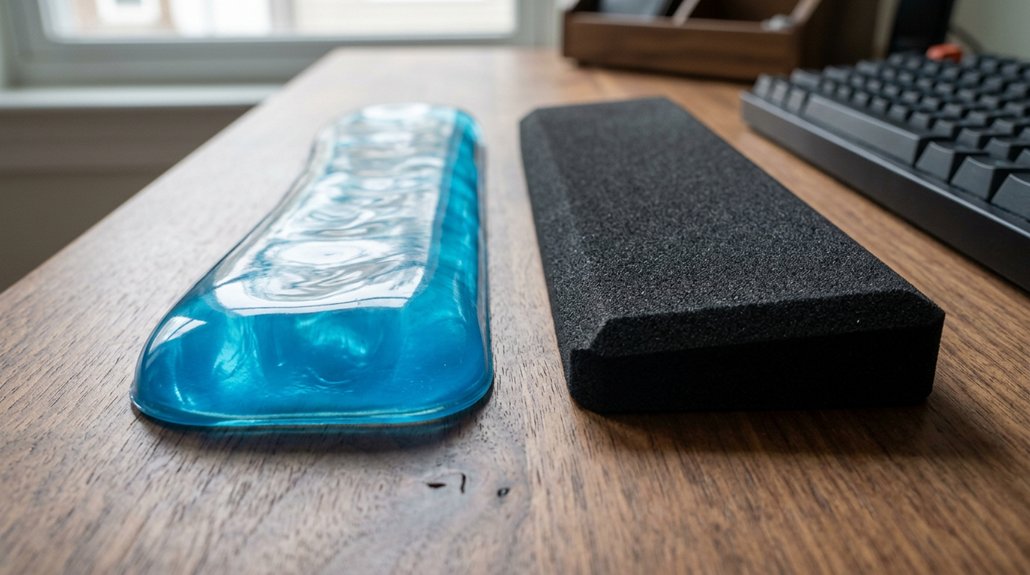
Gel wrist rests beat foam because they offer better pressure distribution, which helps reduce strain on your nerves and tendons. They stay cooler and more comfortable during long use, preventing heat buildup that can worsen discomfort. Gel provides firm, stable support for larger wrists and maintains its shape longer, unlike foam that can flatten over time. If you want to learn how to choose the best option for your needs, keep exploring the details.
How Wrist Rest Materials Impact Carpal Tunnel Support

The material of your wrist rest considerably influences how well it supports the carpal tunnel. Gel wrist rests offer a cooling, invigorating sensation that can help reduce discomfort in warm environments, easing symptoms associated with swelling and heat.
Their initial softness provides immediate pressure relief over bony areas near the carpal tunnel, which benefits users with mild sensitivity. Gel also absorbs motion and dampens impact during typing or mousing, helping to reduce repetitive strain.
Unlike firmer foam, gel maintains a consistent support level, preventing excessive wrist sinking and limiting wrist extension that worsens pressure. High-quality gel pads can provide reliable, ergonomic benefit for carpal tunnel syndrome, offering better wrist support and reducing strain during extended computer use.
Considering the memory foam thickness and material stability of wrist rests can further enhance support and comfort during long typing sessions.
Why Gel Wrist Rests Offer Better Pressure Distribution
Gel wrist rests provide more even pressure distribution compared to firmer foam pads. The semi-fluid nature of gel allows it to contour subtly to your wrist shape, reducing sharp pressure points and spreading the load across a broader area. A more ergonomic contour ensures optimal support and comfort for repetitive movements. Unlike memory foam, which can create localized high-pressure zones as it molds, gel helps maintain consistent surface firmness, preventing uneven pressure on the carpal tunnel. Thicker, denser gel pads offer stable support, reducing the risk of excessive sinking that can disrupt wrist alignment and neutral wrist positioning. Additionally, in warmer environments, gel’s cooler sensation can help decrease swelling and discomfort, further aiding in pressure relief. Overall, gel wrist rests promote better pressure distribution, helping to minimize strain and support proper wrist posture.
How Gel Helps Reduce Tendon and Nerve Strain

When you use a wrist rest that distributes pressure evenly, it can greatly reduce strain on tendons and nerves. Gel wrist rests provide a cool, squishy surface that soothes and minimizes localized tendon and nerve tension by spreading pressure across your wrist.
Their firmer support prevents excessive sinking, helping maintain proper wrist alignment and reducing tendon irritation linked to carpal tunnel syndrome. The gel’s slight springiness absorbs small movements and shocks from typing or mouse use, lowering repetitive microtrauma to nerves and tendons.
Additionally, gel wrist rests maintain consistent firmness, avoiding hotspots that can worsen nerve compression. Their low-friction surface reduces friction-related tendon irritation, decreasing strain risk during repetitive wrist motions.
This combination helps protect your nerves and tendons from unnecessary stress, lowering discomfort and potential injury.
Supporting Neutral Wrist Posture With Memory Foam Wrist Rests
Supporting neutral wrist posture is essential to prevent strain and alleviate symptoms of carpal tunnel syndrome, and memory foam wrist rests are particularly effective in achieving this. Memory foam wrist rests contours gradually to your wrist’s shape, promoting a neutral wrist posture by evenly distributing pressure and reducing localized strain on the carpal tunnel.
Its viscoelastic properties gently compress, ensuring consistent wrist and keyboard or mouse height alignment—crucial for preventing wrist extension or flexion that can worsen symptoms. High-density memory foam maintains ergonomic support during extended use, preventing flattening that could disrupt proper wrist positioning. Additionally, memory foam’s pressure-relief qualities help minimize discomfort during prolonged use, further contributing to wrist health. The even cushioning and adaptive contouring also reduce nerve compression and blood flow restriction, helping to alleviate tingling and numbness. By accommodating various wrist sizes, memory foam wrist rests foster a relaxed, supportive position essential for long-term management of carpal tunnel syndrome.
Which Material Provides the Most Stable Long-Term Support?
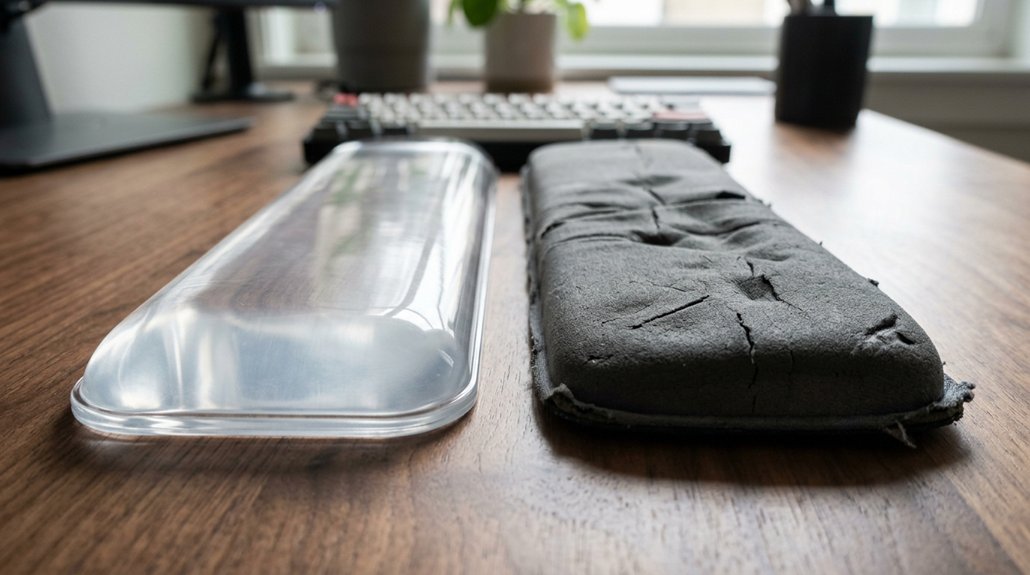
While gel wrist rests initially offer a firm and stable surface, their long-term support can diminish over time due to material degradation. Gel materials may suffer from separation, clumping, or leaks, which reduces support consistency and causes uneven firmness. This can negatively impact neutral positioning and increase pressure points. Additionally, the foam material types used in memory foam wrist rests are designed to withstand prolonged compression without losing their supportive properties. In contrast, memory foam wrist rests maintain their shape and density much better over years, offering more reliable and adaptive support. The high-density viscoelastic properties of memory foam help preserve proper wrist alignment. Additionally, gel wrist rests often have a rigid base that can deform, whereas memory foam contours gradually to your wrist, supporting long-term stability. This makes memory foam a more dependable material for sustained support and comfort.
Gel wrist rests may lose support and cause discomfort over time due to material breakdown.
- Maintains shape and density over years
- Preserves neutral wrist positioning
- Reduces pressure points long-term
Durability and Maintenance of Gel Versus Foam Wrist Supports
Gel wrist supports tend to degrade more quickly over time due to issues like material separation, clumping, leaks, and surface unevenness, all of which can compromise comfort and support. These problems often require earlier replacement compared to foam wrist rests.
While foam wrist rests, especially high-density types, maintain their shape longer because of their resilient structure, gel supports are more vulnerable to material separation and gel migration, leading to hard or uneven spots. Additionally, the non-heat sensitive gel in these supports helps prevent discomfort but does not eliminate wear and tear entirely.
Proper maintenance, such as routine cleaning and gentle drying, helps extend the lifespan of both materials. However, foam wrist rests generally withstand daily wear, sweat, and repeated use better than gel ones, which are more prone to structural failures.
How Breathability and Overheating Differ in Gel and Foam Wrist Rests
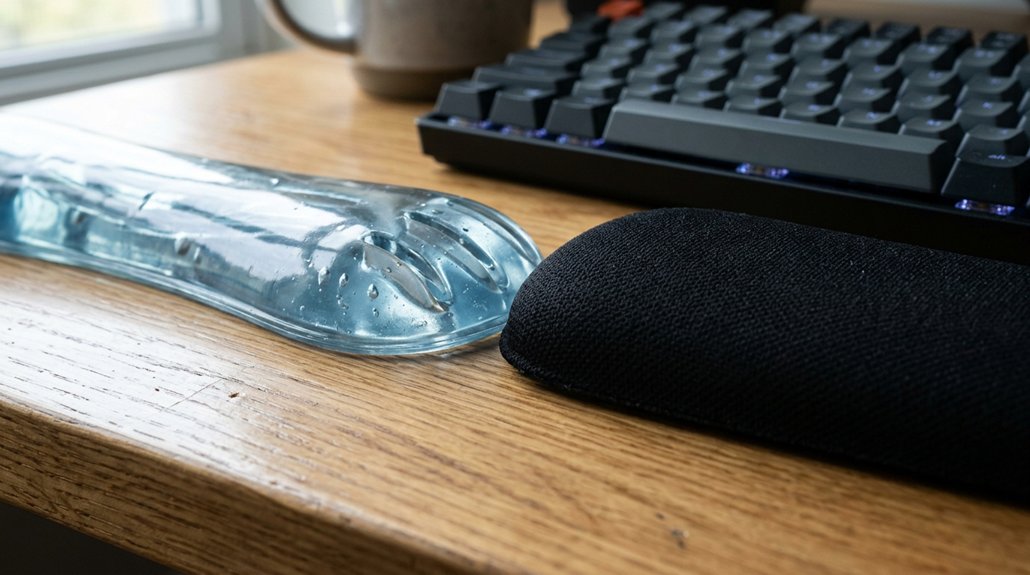
If warmth and heat buildup are concerns for your wrist comfort, the choice between gel and foam wrist rests can greatly impact your experience. Gel wrist rests generally feel cooler and help prevent overheating, making them suitable for warmer environments or sensitive skin.
In contrast, foam wrist rests tend to hold warmth longer due to their viscoelastic properties, which can lead to increased heat retention.
- Gel has lower heat retention but can trap heat if its surface isn’t breathable.
- Foam offers better moisture management with breathable covers, reducing skin irritation.
- Overheating in gel rests is less common but may cause degradation over time, while foam’s warmth may lead to discomfort during extended use.
- The material composition of gel and foam also influences their thermal properties and user comfort.
Choosing the right wrist rest depends on your need for breathability and temperature control.
Which Material Maintains Its Support Best Over Time?
Memory foam tends to hold its shape and cushioning for years, maintaining consistent support. Gel wrist rests, however, are more prone to breaking down, clumping, and gel migration, which can compromise support over time. Additionally, the non-slip rubber bottom on many cushions helps ensure stability, but gel materials often lack this durability, leading to decreased effectiveness.
Memory Foam’s Shape Retention
When it comes to maintaining consistent support over time, high-density memory foam excels thanks to its viscoelastic properties. Your memory foam wrist rests retain their shape better, providing stable support and reducing pressure on your wrist.
Unlike gel wrist rests, which tend to clump, leak, or develop uneven firmness, memory foam gently compresses and rebounds, preserving wrist contouring. This shape retention guarantees support quality stays reliable for years.
The durability advantage of memory foam lies in its resistance to permanent deformation, even with prolonged use. Paired with breathable covers, these wrist rests resist sweat and abrasion, extending their lifespan.
Memory foam’s ability to maintain shape ensures long-term support stability, making it a preferred choice for ergonomic wrist rests.
Gel’s Support Stability
Gel wrist rests initially provide firm and stable support, especially because of their solid base and rigidity. This design helps maintain proper wrist position and supports an ergonomic desk setup, reducing strain.
However, over time, the support stability of gel wrist rests diminishes as the gel migrates and separates, leading to uneven support. Unlike foam wrist rests, which gradually compress, gel pads can develop hard spots or clumps, compromising consistent support.
Although gel maintains its structural firmness longer than softer foam variants, it’s prone to leaks, flattening, or surface degradation that affect support quality. This means you might need to replace gel wrist rests sooner to retain peak support, even though they start out offering more stable support than foam.
Long-Term Material Durability
Over time, the durability of wrist rests depends heavily on the materials used, with memory foam generally maintaining its support longer than gel. Gel wrist rests are prone to material separation, clumping, and leaks, which reduce their ability to provide consistent support. Additionally, the shape of the cushion can influence how well the material holds up under repeated use. Memory foam, especially high-density types, retains its shape and resilience over years, resisting permanent flattening better than gel. Gel pads often develop uneven firmness and surface degradation more quickly, shortening their lifespan. Proper maintenance and breathable covers can extend durability in both materials, but gel requires more frequent replacement. When considering long-term durability, memory foam offers superior support retention, making it a more reliable choice for sustained wrist comfort.
How to Choose the Best Wrist Rest Material for Your Wrist Size and Needs
When choosing a wrist rest, consider your wrist size and how much support you need. Gel rests offer a cooler, squishy feel but may shift with movement, while memory foam molds to your wrist, providing personalized comfort. Think about workstation setup and support longevity to find the best material that keeps your wrist properly supported during long hours. Additionally, selecting a foam with the appropriate foam density can impact support durability and comfort over time.
Matching Material to Wrist Size
Choosing the right wrist rest material depends largely on your wrist size and how much support you need. Gel wrist rests typically offer firmer, consistent support that’s ideal for larger wrists, reducing excessive sinking and maintaining proper pressure distribution.
Foam wrist rests, especially softer memory foam, mightn’t provide enough firmness for bigger wrists, leading to uneven support. If you have smaller or narrower wrists, gel wrist rests could create localized pressure points because they don’t contour as well. Conversely, those with heat or sweat issues may find gel’s cooler surface more comfortable during short sessions.
Think about your wrist size and comfort preferences to select a material that delivers optimal support and pressure distribution without sacrificing durability.
- Larger wrists benefit from gel’s firmness and stability
- Smaller wrists may prefer softer foam for better contouring
- Heat-sensitive users find gel’s cooler surface more comfortable
Prioritizing Support and Comfort
Selecting the right wrist rest material hinges on balancing support and comfort tailored to your wrist size and how you use your device. Gel wrist rests offer immediate comfort through their soft, squishy feel, making them ideal for users with medium to larger wrists who need stable wrist support and pressure distribution.
They provide a quick rebound, minimizing wrist extension and reducing discomfort for short-term use. If you experience carpal tunnel syndrome symptoms, gel rests can help by offering targeted support. However, for prolonged sessions, gel may cause pressure points if not thick enough.
Those with smaller wrists or sensitive skin may prefer gel’s consistent surface, which delivers reliable comfort without excessive contouring. Ultimately, prioritize support and comfort to prevent strain and best manage wrist health.
Practical Tips to Select the Right Wrist Rest Material for Carpal Tunnel Prevention
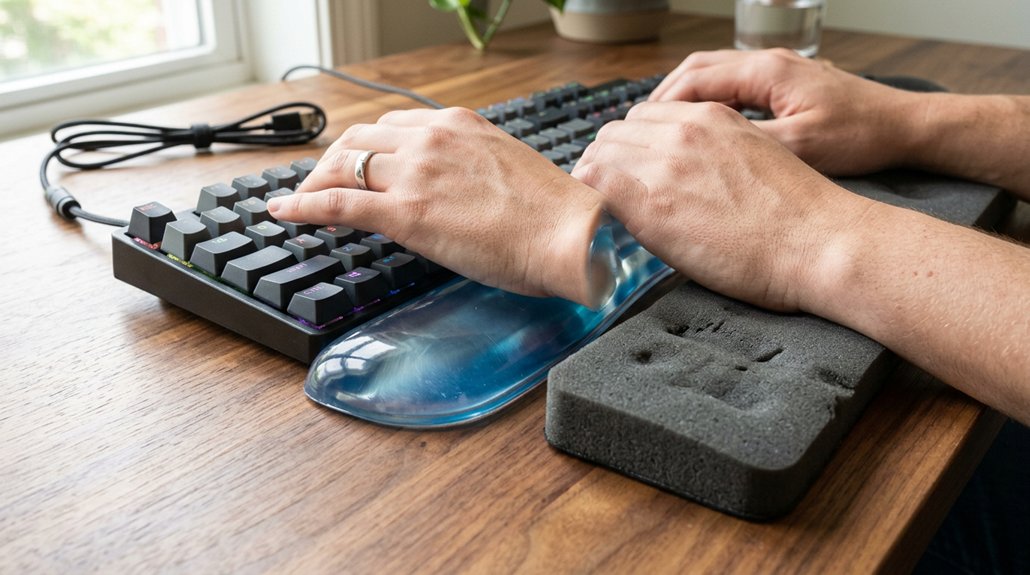
To choose the right wrist rest material for carpal tunnel prevention, it’s important to take into account how each option supports wrist alignment and pressure distribution.
Gel wrist rests provide a cool feel initially and offer firm, immediate support, which helps reduce wrist pain and maintain correct positioning.
To maximize benefits, select gel rests with high-quality gel, a non-slip base, and adequate thickness to prevent uneven pressure points. Be aware that overly thin or uneven gel pads may cause localized pressure that worsens nerve compression.
For best results, combine gel wrist rests with ergonomic gear, regular breaks, and proper workstation setup.
Remember, gel rests are ideal for short-term use and short duration tasks, especially when proper support is prioritized.
- Support wrist alignment with high-quality, thick gel pads
- Guarantee a stable, non-slip base to prevent shifting
- Combine with ergonomic habits for effective prevention
Frequently Asked Questions
Are Gel Wrist Rests Better Than Foam?
Gel wrist rests aren’t better than foam because they feel cooler and softer initially but tend to flatten, cause uneven support, and may lead to awkward angles or discomfort over time, making foam a more durable, consistent choice.
What Is the Best Wrist Rest for Carpal Tunnel?
The best wrist rest for carpal tunnel offers firm, supportive gel cushioning that maintains neutral wrist position, reduces pressure, and minimizes movement. Avoid low-quality options; prioritize durability and stable support to prevent aggravating your symptoms during prolonged computer use.
What Fruit Helps With Carpal Tunnel?
You should eat cherries and blueberries because they’re rich in antioxidants and flavonoids, which help reduce inflammation and support nerve health, potentially easing carpal tunnel symptoms. Incorporating these fruits can promote better wrist comfort.
What Is the Best Position for Wrists to Prevent Carpal Tunnel?
You should keep your wrists in a neutral position, with a straight line from your forearm to your hand, avoiding bends or excessive elevation. This minimizes nerve compression and reduces your risk of developing or worsening carpal tunnel syndrome.
In Summary
Choosing the right wrist rest can make a real difference in managing carpal tunnel. Gel wrist rests excel at providing better pressure distribution and reducing strain, helping maintain neutral wrist posture. They’re also more breathable and durable over time compared to foam. By considering your wrist size and needs, you’ll find a support that keeps you comfortable and reduces discomfort. Invest in the right material to protect your wrists and improve your typing experience every day.